|
Ardbeg Distillery - Visitor Center & Old Kiln Cafe:
Easter to end September
Shop open Monday to Friday 10:00 to 17:00
June to August
Open seven days - Tours at 10:30 and 15:00
October to Easter
Shop open Monday to Friday 10:00 to 16:00. Tours at 10:30 and 15:00
Old Kiln Café
Open all year Monday to Friday (June to August open seven days) 10:00 to 16:00
Current owner: Glenmorangie plc
Distillery Manager: Michael Heads
jthomson@glenmorangie.co.uk
www.ardbeg.com
+ 44 (0) 1496 302244
+ 44 (0) 1496 302040
Ardbeg History and Distillery Information
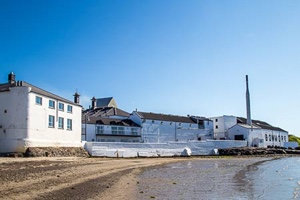
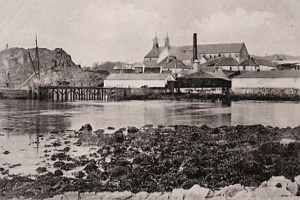
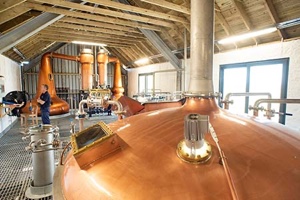
Ardbeg distillery was established in 1815 and operated as a Private Ltd. Co. until january 1977 when it was taken over by Hiram Walker (producers of Ballantine), who sadly demolished the best of the maturing warehouses, and later by Allied Distillers, who, due partly to over production but also down turn in the whisky industry 'mothballed' the distillery in 1981. Ardbeg remained silent until 1989. During those years the buildings were allowed to fall into disrepair. Ardbeg Distillery was bought and reopened in 1997 by Glenmorangie Plc, and is now one of the fastest growing Islay malts. Glenmorangie invested heavily in refurbishing the buildings and plant. To maintain Ardbeg's very distinctive character, the specification of malt used in the production of Ardbeg requires to be at a minimum level of 50 p.p.m. phenol. Glenmorangie Plc. is jointly owned by the French company, LVMH, and the British company, Diageo. At Ardbeg they currently produce 160 barrels a week. With each barrel they fill 250 bottles and so they produce a staggering 40.000 bottles of whisky each week. For that they work continuously, 24 hours a day, 6 1/2 days a week with 6 persons in the distillery and 3 in the warehouse. At the moment of writing the warehouses were completely full. Because of that the maturing takes place in other warehouses in Edinburgh. Ardbeg distillery get their Barley from Port Ellen Maltings. 60 tons of very peaty barley each week. Visitors to Ardbeg will find an added bonus, the very fine "Kiln Café" where all sorts of delights can be enjoyed, including a taste of the end product.
The Ardbeg Committee has been established in 2000 to "promote the advancement of general knowledge and enjoyment of Ardbeg". All Ardbeg-aficionados can join this Committee on Ardbeg's website. Special bottlings can sometimes be obtained by members of this committee.
Related info: Alfred Barnard's visit to Ardbeg Distillery in the 1880s
Bottlings
Ardbeg often bottles its whiskies at a higher alcohol level than the minimum 40% ABV. Many bottlings are also non-chillfiltered. Both measures contribute to produce a full-flavoured whisky.
Here are the most important bottlings of Ardbeg:
Ardbeg Very Young - Committee Approved, 58.3% ABV. In 2004 this 6yo was released, and the distillery plans on releasing an older version every year until new stocks reach 10 years. Very Young Ardbeg - For Discussion was first sold in 2003 as a 6 yo, to give Ardbeg-lovers the chance to taste the first whisky produced since the reopening in 1997.
Ardbeg 10yo, 46% ABV, which is the most regular and widely available edition.
Ardbeg 17yo, 40% ABV, increasingly harder to find since the distillery was closed from 1981 to 1997, and stocks are low.
Ardbeg Uigeadail, (no age), 54.2% ABV, named after the loch that provides the distillery with water. Pronounce oog-a-dal.
Ardbeg 25yo, Lord of the Isles, 46% ABV.
Serendipity, 40% ABV, An unintentional bottling of very, very old Ardbeg with 12 years old Glen Moray
Independent bottlings are often available.
|