Islay Malt Whisky & Islay Distilleries
Islay Peat and Water
Islay is very largely composed of peat. The water on Islay is brown, even the water in the burns is brown, and winter gales drive salt spray far inland, and this saturates the peat, which is dried again by the briny, seaweedy breeze. All these characteristics go into the whiskies of Islay, to a greater or lesser extent.
Strongest flavoured
There are eight distilleries on the island, all coastal and battered by salt-winds, except for the new Kilchoman Distillery. Among their products are the strongest flavoured of all malt whiskies, a property which endears them to some and disgusts others. Most of the maltings, used for the production of whisky on Islay, is done at Port Ellen Maltings according to the specific specs (peat level) of each distillery.
Southern distilleries
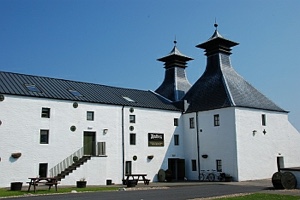
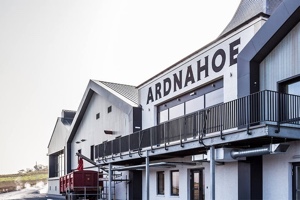
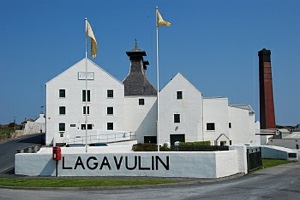
The southern distilleries - Ardbeg, Laphroaig, Lagavulin, Port Ellen (the latter was closed in 1983) - are the most powerful, producing medium-bodied whiskies, saturated with peat-smoke, brine and iodine. Not only do these distilleries use heavily peated malt (54 ppm at Ardbeg, 40 ppm at Laphroaig), they use the island's brown water for every stage of production - until they were closed in the early 1980s, Ardbeg had its own floor maltings and used to steep the barley in the same water.
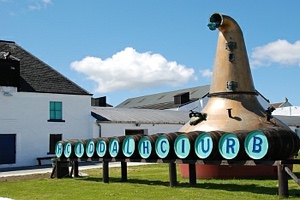
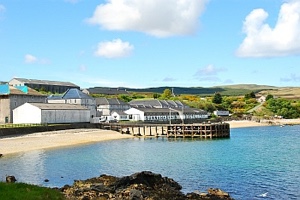
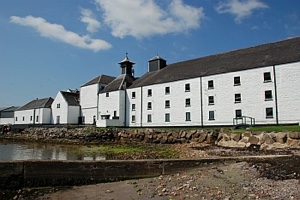
Bruichladdich Distillery seen from the pier
Northern distilleries
The northern Islay distilleries - Bruichladdich (the 'ch' is silent) and Bunnahabhain ('Boona-hah-ven') are, by contrast, much milder. These draw their water direct from the spring, before it has had contact with peat, and use lightly or un-peated barley. The resulting whiskies are lighter flavoured, mossy (rather than peaty), with some seaweed, some nuts, but still the dry finish.
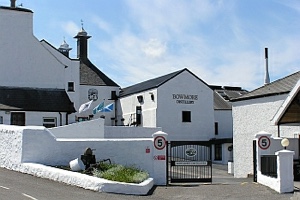
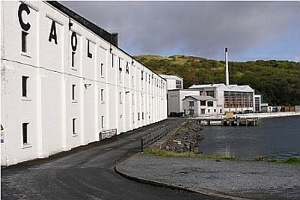
Bowmore Distillery, in the middle of the island on the shore of Loch Indaal, stands between the two extremes - peaty but not medicinal, with some toffee, some floral scents, and traces of linseed oil. Caol Ila ('Cal-eela'), although close to Bunnahabhain, produces a delicate, greenish malt, with some peat/iodine/salt balanced by floral notes and a peppery finish.
Kilchoman: A Farm Distillery
Kilchoman (pronounced kilhoman) is a Farm Distillery and the first to be built on Islay for 124 years. It is the 8th distillery on the Island and opened in 2004. The whole production process is done on Islay including growing their own Barley on the Island. The location of the distillery is near Loch Gorm and only 500 metres (as the crow flies) from Machir bay on the Atlantic Ocean. The perfect ingredients for another great Islay Malt.
Port Ellen Warehouses and Maltings seen from the Ferry
Islay Malts' Characteristics
Islay whiskies generally reverse the characteristics of Speysides, tending to be dry and peaty; behind the smoke, however, can be gentle mossy scents, and some spice. The southern Islay distilleries produce powerfully phenolic whiskies, with aromas redolent of tar, smoke, iodine and carbolic. Bowmore, in the middle of the island, shares these characteristics but is not quite so powerful, as does Caol Ila. Bruichladdich and Bunnahabhain are lighter and much less smoky. All Islay's Matls have a dry finish, the southern ones with quite a bite.
A new chapter in Islay's Whisky history is written:
A newcomer and Islay's ninth distillery will be the Port Charlotte Distillery, its opening being announced in March 2007 and is expected to be a rather peaty whisky. The new Port Charlotte Distillery will open its doors in 2009 and is located in the centre of Port Charlotte using the old buildings of the former Lochindaal Distillery.
Related Information:
Islay Distilleries Pictures - The Inside and outside of every Islay Distillery
Islay's Lost Distilleries
A History of Whisky on Islay and Jura
Alfred Barnard's Distillery travels in the 1880s
The Northern Distillery of Bunnahabhain at the Sound of Islay
|